Course Details


Why choose APU?


Requirements
Admission Requirements
- 3 Credits in at least 3 subjects at SPM level, with a minimum of a pass in Bahasa Malaysia and Sejarah (History);
- 3 Credits (Grade C & above) in at least 3 subjects at IGCSE/O-Levels;
- 3 Credits (Grade B & above) in at least 3 subjects in UEC;
- Pass relevant Certificate Programme or its equivalent;
Note: The above entry requirements may differ for specific programmes based on the latest programme standards published by Malaysian Qualifications Agency (MQA). The qualification and entry requirements for the programmes will be determined based on the "Comparison List of Equivalency of International Qualifications with SPM (O-Levels equivalent) and STPM (A-Levels equivalent)" published by Malaysian Qualifications Agency (MQA).
- IELTS : 5.0
- TOEFL IBT : 2.5
- Pearson (PTE) : 47
- MUET : Band 3.5
For more information please click HERE
Programme Outline
What We Teach
This APU Diploma in Business Information Technology is designed to provide:
- Students for careers in hybrid environments where business information systems are increasingly integrated, encompassing a wide range of enabling technologies and cross-organisational, social, national and international boundaries.
- Students with academic and professional skills to develop solutions requiring the application of both business and information technology disciplines in a commercial and organisational context.
- Students with critical, independent and cooperative learning skills so as to facilitate responses to continuous future changes in technology and industry practices.
- Students with intellectual skills, communications ability and team working capability.
-
Semester 1
Semester 1 builds essential academic, business, and digital foundations. Students develop research and communication skills, core business management knowledge, and practical IT abilities. Digital thinking and innovation foster creativity, problem-solving, and adaptability, preparing students for integrated business and technology learning.
Modules
- Academic Research Skills
- Digital Thinking and Innovation
- Managing Business
- Practical IT Skills
-
Semester 2
Semester 2 develops professional communication, analytical, and organisational skills. Information systems highlight technology’s role in business processes, people management focuses on human resources, and quantitative methods strengthen data analysis for informed decision making in technology-enabled organisations.
Modules
- Professional Communication
- Information Systems
- People Management
- Quantitative Methods
-
Semester 3
Semester 3 advances core business and analytical skills. Statistical methods and business economics strengthen quantitative and economic reasoning, while marketing develops strategic market analysis and customer-focused decision-making for data driven, technology-enabled business environments.
Modules
- Statistical Method
- Marketing
- Business Economics
-
Semester 4
Semester 4 develops strategic, financial, and entrepreneurial perspectives. Strategic management and ethics promote responsible decisions, international business and accounting build global and financial literacy, and entrepreneurship introduces venture creation for competitive and ethical business contexts
Modules
- Strategic Management & Ethics
- International Business
- Introduction to Accounting
- Fundamentals of Entrepreneurship
-
Semester 5
Semester 5 focuses on advanced business and IT integration. Systems analysis, internet applications, and digital operations management build skills in planning efficient, sustainable IT solutions, while organisational behaviour enhances understanding of workplace dynamics and real-world organisational challenges.
Modules
- Organisational Behaviour
- System Analysis and Design
- Internet Application
- Digital Operations Management
-
Semester 6
The final semester prepares students for employment or further study through digital commerce, finance, and legal compliance. E-commerce examines online operations, banking and finance build financial awareness, and business law strengthens regulatory understanding for ethical, informed decision-making.
Modules
- E- Commerce
- Principles of Banking and Finance
- Legal Framework of Business
** In addition to the above, all students are also required to successfully complete General Studies modules as stipulated by the Malaysian Qualification Agency, as well as fulfill credit requirements for Co-Curricular Activities.
-
Further Studies (Degree - Year 2)
Upon successful completion of this programme and fulfilment of requirements for credit transfer, you will be eligible to progress into Level 2 of the following degree programmes offered at APU.
- Bachelor of Arts (Honours) in Business Management
- Bachelor of Arts (Honours) in Business Management with a specialism in:
- E-Business
- Digital Leadership
- AI & Business Analytics
- Business Economics
- Bachelor of Arts (Honours) in International Business Management
- Bachelor of Arts (Honours) in International Business Management with a specialism in:
- Supply Chain Management
- Bachelor in Digital Marketing (Honours)
- Bachelor of Arts (Honours) in Human Resource Management
- Bachelor of Arts (Honours) in Human Resource Management with a specialism in:
- People Analytics
- Bachelor of Arts (Honours) in Tourism Management*
* Please take note that Bridging module(s) needed before progress into Level 2
For the full listing of our Diploma Programmes, please refer to the Pre-University programme brochure. -
Further Studies (Degree - Year 1)
Upon successful completion of this programme with CGPA of 2.75 or higher you will be eligible to advance to Level 1 with transferred credits. Students with 2.5 CGPA must pass rigorous assessment.
- Bachelor of Science (Honours) in Information Technology
- Bachelor of Science (Honours) in Information Technology with a specialism in:
- Cloud Engineering
- Financial Technology (FinTech)
- Business Information Systems
- Information System Security
- Sustainable Computing
* Please take note that students who wish to progress to BSc (Hons) in Information Technology or its specialism, require a Credit Pass in Mathematics at SPM or a Credit Pass in Mathematics at Diploma in Business Information Technology. Candidates with only a pass in Mathematics need to take and pass the reinforcement Mathematics.
For the full listing of our Diploma Programmes, please refer to the Pre-University programme brochure.
Diploma
Explore related programmes
- Diploma in Information & Communication Technology
- Diploma in Information & Communication Technology with a specialism in Software Engineering
- Diploma in Information & Communication Technology with a specialism in Data Informatics
- Diploma in Information & Communication Technology with a specialism in Interactive Technology
- Diploma in Business Administration
Facilities at APU
The APU Centre Point & Atrium serves as a melting pot of cultures from all over the world. Here, cultural activities are organised regularly at the campus, fostering long-lasting intercultural relationships among APU students, who come from over 130 countries.

Dual Degree
APU-DMU Dual Degree Programme
Students who are under Bachelor’s Degree Programme will have the option to opt-in for the APU-DMU Dual Degree Scheme. Under this Scheme, students will receive 2 Degree Certificates & Transcripts upon graduation: 1 from Asia Pacific University (APU), Malaysia and 1 from De Montfort University (DMU), UK.
Ready, Set, Go.
Whether you are locals or traveling here, we have the options for you to pursue your dreams.
RM47,600
Total for Malaysian
RM54,200
(USD14,265)
Total for International
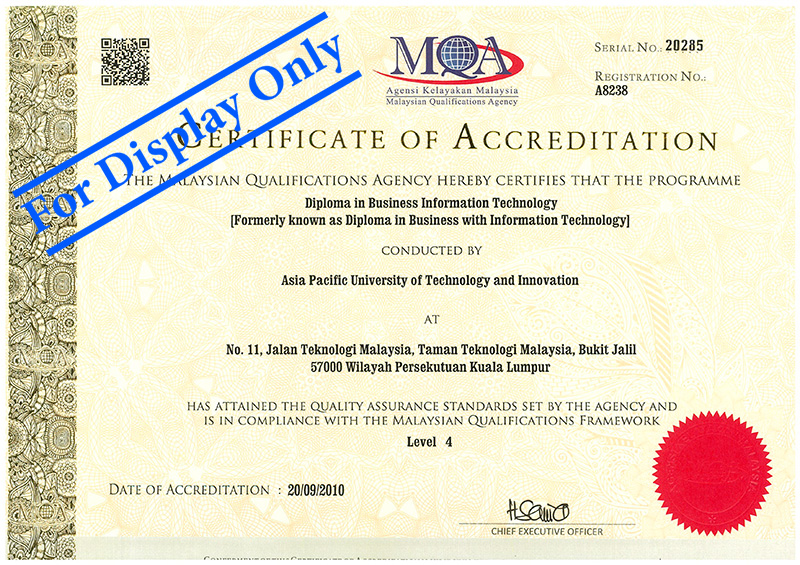
Programme code : (R4-DL/0410/4/0018)(12/31)(A8238)
All information is correct at the time of publication, but is subject to change in the interest of continuing improvement.
Note : All fees are payable in Ringgit Malaysia (RM). Any USD amounts indicated by APU are for reference only and are non-binding. The final amount payable is the RM amount stated in the official invoice, and the University will not entertain any claims arising from foreign exchange fluctuations.
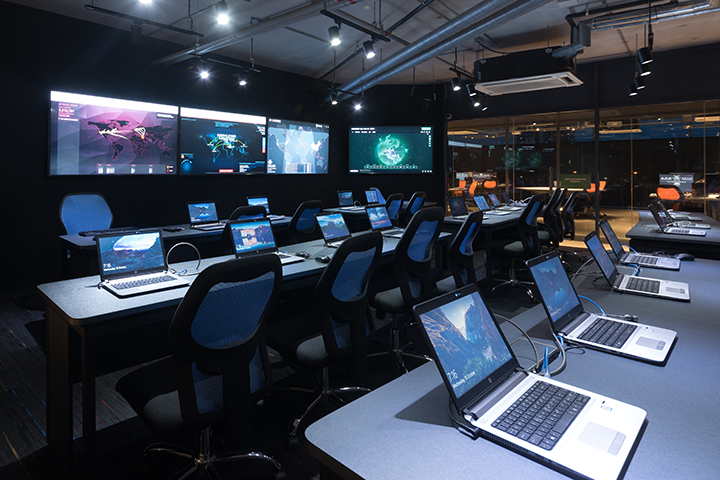
Campus Facilities
Learn More
Pathways @ APU
Learn MoreEnglish Language Study
Korean Language
U-Start Programme
Want to know more ?
Let’s Connect